Many law firms invest in SEO to rank higher for competitive searches like personal injury lawyer near me, divorce attorney, or business litigation lawyer.
At the same time, accessibility has become an increasingly important topic.
This raises a common question:
Can improving your website's accessibility help your law firm's SEO?
The answer is yes, but indirectly.
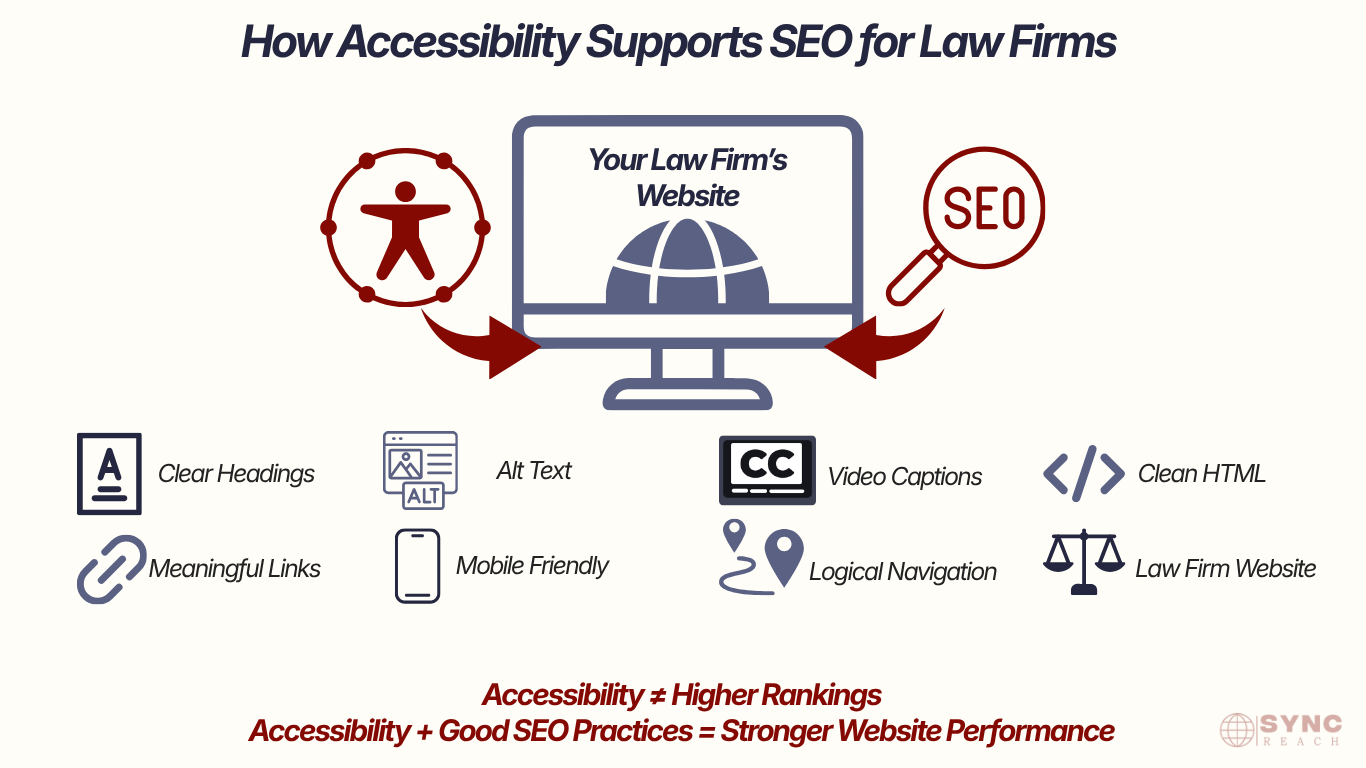
Accessibility isn't a Google ranking factor on its own. However, many accessibility improvements naturally align with technical SEO best practices, creating a website that's easier for both users and search engines to understand.
For firms competing in crowded legal markets, those improvements can contribute to stronger long-term search performance.
Search Engines and Visitors Want the Same Thing
Google's goal is to deliver websites that provide a great user experience.
Prospective clients want to find legal information quickly, understand what your firm does, and contact you without frustration.
When your website is organized in a way that's easy for people to navigate, it also becomes easier for search engines to crawl and interpret.
That's where accessibility and SEO begin to overlap.
Better Structure Helps Search Engines Understand Your Content
Search engines don't "see" a webpage the way people do.
Instead, they analyze your page structure, headings, HTML, and content hierarchy.
A well-structured page allows Google to identify:
- your primary practice area
- your geographic location
- supporting legal services
- frequently asked questions
- related content
For example, a page titled Estate Planning Attorney in Phoenix becomes easier to interpret when it's organized with logical headings instead of large blocks of unstructured text.
This improves crawlability while making the page easier for visitors to scan.
Strong Internal Linking Builds Authority
Many law firm websites treat every practice area as an isolated page.
Instead, related pages should naturally connect.
For example:
- Personal Injury → Car Accidents
- Car Accidents → Truck Accidents
- Truck Accidents → Wrongful Death
- Wrongful Death → Attorney Profile
This helps visitors discover relevant information while allowing search engines to understand how your content is connected.
A stronger internal linking strategy can improve crawl efficiency and distribute authority across important pages.
Accessibility Encourages Better Content Organization
One overlooked benefit of accessibility is that it encourages content to become more readable.
Instead of overwhelming visitors with long paragraphs of legal terminology, accessible content often includes:
- descriptive headings
- concise paragraphs
- numbered steps
- bullet lists
- clear calls to action
This doesn't just help users with disabilities.
It benefits busy prospective clients who are researching legal options from their phone during a lunch break or after work.
When visitors can quickly find the information they need, they're more likely to stay on your website and continue exploring.
Improved User Experience Can Influence SEO Performance
Google has repeatedly emphasized creating helpful, people-first content.
While Google doesn't publicly use metrics like bounce rate as direct ranking factors, user experience can still influence your website's overall effectiveness.
A website that's easier to navigate may encourage visitors to:
- view additional practice areas
- spend more time learning about your attorneys
- complete a consultation request
- return later when they're ready to hire legal counsel
Even if rankings don't change overnight, improving usability can increase the value of the traffic you're already earning.
Accessibility Supports Local SEO Efforts
Most law firms rely heavily on local search.
Whether someone searches for family lawyer in Toronto or criminal defense attorney in Dallas, Google's goal is to deliver the most relevant and trustworthy results.
An accessible website supports local SEO by making important information easier to locate, including:
- office locations
- contact information
- attorney biographies
- business hours
- consultation forms
When these pages are easy to access and understand, both users and search engines can interact with them more effectively.
Accessibility Makes Your Content More Future-Proof
Search engines continue evolving toward understanding content the way humans do.
Features like AI-generated search summaries and voice search rely on content that's clearly organized and easy to interpret.
While no one can predict future ranking algorithms, websites with clean structure, descriptive content, and logical organization are generally better positioned to adapt as search technology evolves.
Investing in accessibility today isn't just about current SEO, it's about building a website that's easier to maintain and optimize over time.
Think Beyond Rankings
The biggest benefit of accessibility may not be higher rankings at all.
It can help ensure that every potential client, regardless of how they browse the web, has an equal opportunity to learn about your services and contact your firm.
From a marketing perspective, that's valuable because every barrier removed is one less obstacle between a prospective client and your intake team.
Final Thoughts
Accessibility and SEO aren't the same thing, but they often move in the same direction.
By creating a website that's easier to navigate, understand, and interact with, law firms can strengthen the technical foundation that supports long-term organic visibility while also improving the experience for prospective clients.
Rather than viewing accessibility as a separate project, consider it part of building a higher-performing website, one that's designed for both people and search engines.
Sources
- Google Search Central. SEO Starter Guide — https://developers.google.com/search/docs/fundamentals/seo-starter-guide
- Google Search Central. Creating Helpful, Reliable, People-First Content — https://developers.google.com/search/docs/fundamentals/creating-helpful-content
- Google Search Central. Page Experience — https://developers.google.com/search/docs/appearance/page-experience
- Nielsen Norman Group. Scannable Web Content — https://www.nngroup.com/articles/how-users-read-on-the-web/
- W3C Web Accessibility Initiative. Accessibility, Usability, and Inclusion — https://www.w3.org/WAI/fundamentals/accessibility-usability-inclusion/